Like us!
 Follow us!
 Follow us !
 Follow us!
 Contact us!
 Subscribe!
 Follow Us!
 Follow Us!


- Standard Immigration 28 January 2026
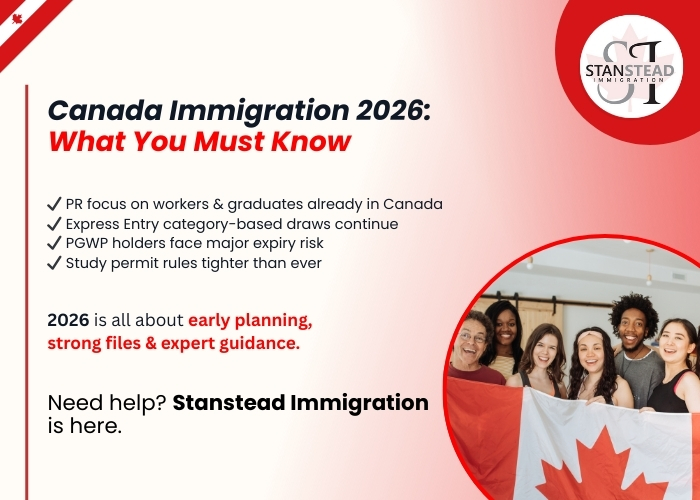
Canada Immigration 2026: What You Must Know
Canada Immigration in 2026 is shaping up to be more strategic, selective, and competitive than previous years. With changing priorities, tighter study permit rules, and a stronger focus on candidates already in Canada, early planning has never been more important.
If you are planning to study, work, or apply for Permanent Residence (PR) in Canada, here’s what you must know about Canada Immigration in 2026.
Canada Immigration 2026: A Clear Shift in Strategy
Canada’s immigration system in 2026 is no longer just about eligibility — it’s about relevance, readiness, and alignment with labour market needs.
The government is prioritizing:
-
Skilled workers already contributing to Canada
-
International graduates with Canadian education and experience
-
Category-based selection over general draws
-
Quality applications over volume
Strong PR Focus on Workers & Graduates Already in Canada
One of the biggest Canada immigration trends in 2026 is the preference for candidates who are already in Canada.
This includes:
-
Temporary foreign workers
-
International graduates
-
PGWP holders
-
Candidates with Canadian work experience
Why this matters:
-
These applicants integrate faster
-
They already fill labour shortages
-
They require fewer settlement resources
If you are inside Canada, your PR chances are stronger in 2026 — if your profile is planned correctly.
Express Entry Category-Based Draws Will Continue
In 2026, category-based Express Entry draws will remain a key selection method.
Canada will continue inviting candidates from priority sectors such as:
-
Healthcare
-
STEM
-
Skilled trades
-
Transport
-
Agriculture & agri-food
-
French-language proficiency
This means:
-
CRS score alone is not enough
-
Your occupation and category alignment matter more than ever
-
Profile optimization is critical
PGWP Holders Face Higher PR Risk in 2026
Post-Graduation Work Permit (PGWP) holders must be extremely careful in 2026.
Challenges include:
-
Expiring PGWPs with limited extension options
-
Increased competition in Express Entry
-
Stricter employer and job relevance checks
-
Fewer “general” PR invitations
Without a clear PR or status extension strategy, many PGWP holders risk losing legal status.
Early planning and expert guidance can make the difference between PR approval and refusal.
Study Permit Rules Are Tighter Than Ever
Canada has significantly tightened study permit rules, and this trend continues in 2026.
Key changes include:
-
Limited study permit quotas
-
Higher financial requirements
-
Increased scrutiny of colleges and programs
-
Stronger checks on study-to-PR intent
Students must now prove:
-
Genuine study purpose
-
Career relevance
-
Clear long-term immigration planning
Random or low-quality applications are more likely to be refused.
2026 Is All About Early Planning & Strong Applications
Canada Immigration 2026 is not for last-minute decisions.
Successful applicants will have:
-
Well-planned immigration pathways
-
Strong documentation
-
Clear timelines (study ? work ? PR)
-
Professional representation where needed
Mistakes, delays, or weak filings can cost years — or even your chance to stay in Canada.
How Stanstead Immigration Services Can Help You in 2026
Navigating Canada Immigration in 2026 requires expert strategy, not guesswork.
Stanstead Immigration Services provides:
-
Personalized PR & visa strategy
-
Express Entry & category-based draw guidance
-
Study permit & PGWP planning
-
Work permit & status extension support
-
End-to-end application management
We help you plan early, file strong, and stay compliant with IRCC rules.
Final Thoughts: Prepare Now for Canada Immigration 2026
Canada Immigration 2026 rewards those who plan ahead and apply smartly. Whether you are a student, worker, graduate, or PR aspirant, early action is your biggest advantage.
Need expert guidance?
Connect with Stanstead Immigration Services today and secure your future in Canada with confidence.